Billing
The Billing Burden Has Quietly Outgrown Most In-House Teams
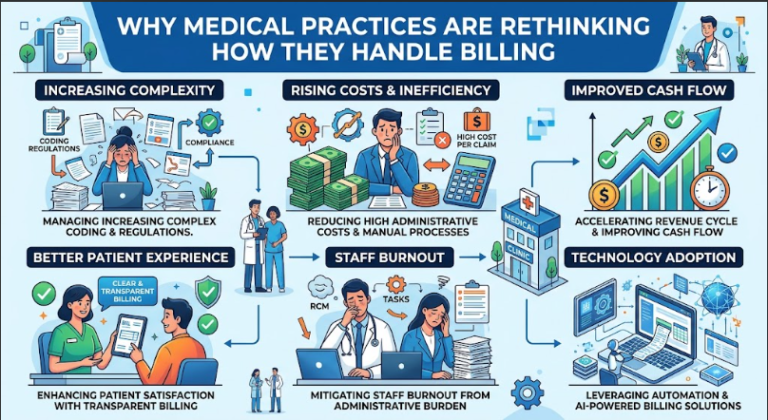
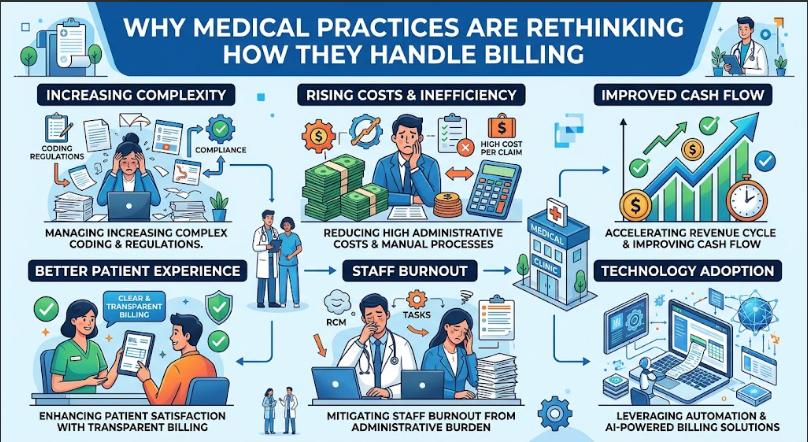
Medical billing used to be a back-office task handled by a couple of staff members who understood the basics of coding and claims submission. Over the past decade, that job has expanded into something far more complicated, involving payer-specific rules, constantly shifting compliance requirements, and software systems that demand near-constant updates. Practices that once managed fine with a small billing department now find themselves stretched thin, watching claim denials pile up while staff struggle to keep pace with payer policy changes.
The result is a slow erosion of cash flow that many administrators do not notice until it becomes a crisis. Denied claims sit unresolved for weeks, appeals go unfiled, and patient balances linger past the point where collection becomes realistic. Staff turnover makes things worse, since every departure means retraining someone new on coding nuances and payer quirks that took months to learn. None of this stems from a lack of effort; it comes from asking a small internal team to do work that has become a specialized discipline in its own right.
Many administrators describe the feeling as running faster just to stay in place. New regulations arrive before old ones are fully understood, and software vendors push updates that require retraining staff who are already stretched across multiple duties. The cumulative effect is a billing operation that reacts to problems instead of preventing them, which quietly drains revenue month after month.
Shifting the Workload to Specialists Who Live in This System Daily
This is where many practice administrators start weighing the benefits of outsourcing RCM services against the cost of continuing to manage everything internally. Outsourcing shifts the technical burden of claims submission, denial management, and payment posting to a team whose entire function is built around keeping that process accurate and current. Instead of a front-desk employee juggling billing between patient check-ins, a dedicated team tracks claim status daily and catches errors before they turn into denials.
The financial case tends to be the most persuasive argument for practices on the fence. Outsourced billing teams typically process claims faster and with fewer errors simply because that is the only task they focus on all day. Practices often see collection rates improve within a few months of transitioning, partly because specialized teams catch coding mistakes that in-house staff, spread across multiple responsibilities, tend to miss.
There is also a staffing stability angle that gets overlooked. When a billing specialist leaves an in-house team, the knowledge gap can take months to close. An outsourced partner absorbs that turnover risk internally, so the practice never experiences a disruption in claims processing because one employee moved on to a different job.
Beyond the numbers, there is a cultural shift that happens once outsourcing takes hold. Physicians and front-office staff stop fielding billing questions they were never trained to answer, freeing them to focus on patient care instead of claim disputes. That shift in attention, while harder to measure than a collection rate, often shows up in staff morale and in how smoothly the front desk runs day to day.
Questions Worth Asking Before Signing With Any RCM Partner
Not every revenue cycle management company operates with the same level of transparency or technical depth, so practices need a clear set of questions before committing to a vendor. Ask how claim denials are tracked and whether the company provides visibility into which codes or payers generate the most rejections. A partner that cannot explain its denial patterns in detail is unlikely to be improving them in any measurable way.
Pricing structure matters just as much as performance claims. Some vendors charge a flat fee regardless of collections, while others take a percentage of what they actually recover, which aligns their incentives with the practice’s financial outcomes. It is worth asking for references from practices of similar size and specialty, since a billing company that excels with a large multi-specialty group may not have the same results with a small primary care office.
Staying current on payer requirements is another area to probe carefully, since rules around prior authorization and claims documentation change often enough to trip up even experienced billers. Resources like the AMA medical billing resources offer useful context on how claims processing standards are evolving industry-wide, and a vendor’s familiarity with those standards says a lot about how seriously they take compliance. Practices should also ask how a potential partner handles patient-facing billing questions, since poor communication at that stage can undo gains made elsewhere in the revenue cycle.
Finally, consider how a vendor reports performance back to the practice. Monthly summaries filled with vague percentages are less useful than detailed breakdowns showing denial reasons, days in accounts receivable, and collection timelines by payer. A billing partner willing to share that level of detail is generally one that has nothing to hide about how the work actually gets done, and that transparency tends to predict a smoother working relationship over time. Practices that take the time to ask these questions upfront tend to avoid the frustration of switching vendors twice within a year.
About the Author